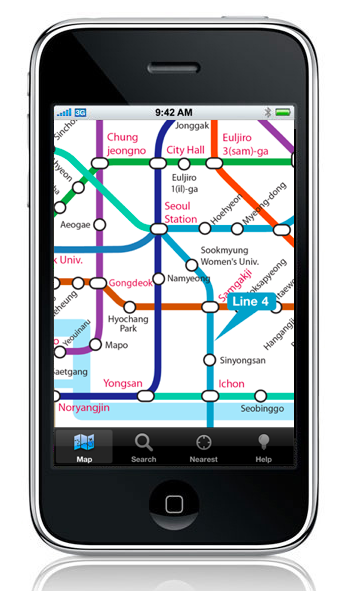
We're delighted to announce that Explore Seoul Subway Map is now available on the iTunes App Store! It's the seventh ExploreMetro app, and our first in Korea! The Seoul Subway is one of the biggest and busiest metro systems in the world. Now you can have an easy-to-use map with all 15 lines and 463 stations in your pocket, in English and Korean.
Fully up-to-date for 2011 Accurate subway map, includes every station on every line of the Seoul Subway. Free updates for future station openings and timetable changes.
Retina display and iPad support Gorgeous maps which look great on the iPhone 4 and iPod touch (4th generation) high-resolution display.
Ready for iPad and iPad 2 Specially redesigned interface for the larger iPad screen. Flip the map over to see stations on a Google Map. View the video.
Google Maps for every station Need to get your bearings at a station? Integrated Google Maps show you metro exits and nearby streets for every station.
Route-planner A really easy route-planner. Get route, time and price information for any journey with just three taps.
"Find my nearest station" Using your iPhone's GPS, see a list of the closest metro stations to your current location.
Works offline Everything works without an Internet connection. Search stations and plan routes on the go. Yes, even offline street maps!
We're really keen to hear your feedback and suggestions about how to make Explore Seoul better. If you're a fan of our other apps, updates to version 5 will be available very soon.
One of the most requested features since we launched ExploreMetro's apps for iPhone, iPod touch and iPad is offline street maps. It's really handy to have a metro map for Shanghai, Beijing, Guangzhou, Taipei, Singapore or Hong Kong in your pocket, but many travellers don't have a 3G connection while travelling, so they're not able to access the Google Maps we provide for each station.
How do I get offline street maps? With version 5.0 of our apps, we're introducing Offline Street Maps for the first time! Version 5.0 of our apps are currently in review by Apple. We expect them to be available in mid-June 2011. They'll initially be available on iPhone and iPod touch. To access offline street maps, tap a station, tap "Street Map", then choose "OSM" (this is the default if your internet connection is offline).
Why can't you just use Google Maps offline?
Unfortunately Google Maps' terms of service do not allow us to provide cached/offline maps. So, instead we've turned to Open Street Map.
What is Open Street Map?
"OpenStreetMap creates and provides free geographic data such as street maps to anyone who wants them. The project was started because most maps you think of as free actually have legal or technical restrictions on their use, holding back people from using them in creative, productive, or unexpected ways." All the information on Open Street Map's map of the world has been manually entered by volunteers. If you're interested in helping out, check out Open Street Map's wiki.
Won't this make the app much larger, if you have to embed maps for every station?
We've tried to keep the filesize as small as possible. Only a small area around each station is included. The total size for all 241 Shanghai maps is just 6MB, for example.
The offline street maps are incomplete or wrong
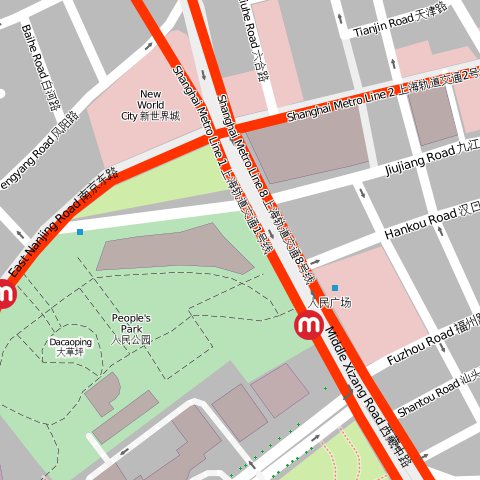
The completeness and accuracy of Open Street Map's data varies by location. For example, here's our offline street map of People's Square in Shanghai compared to the equivalent Google Map:
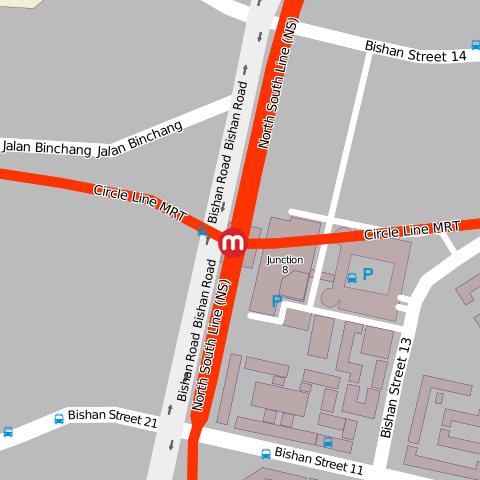
Here's Bishan in Singapore. A few roads are missing.
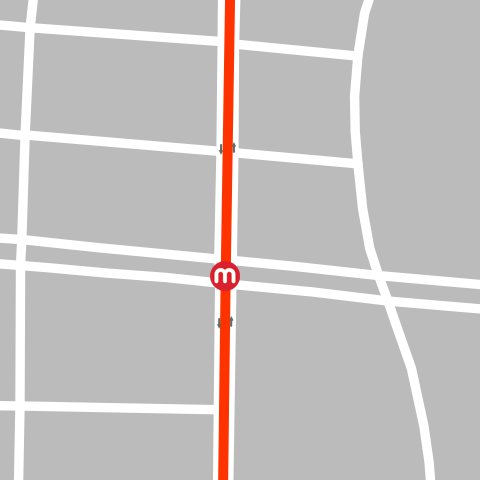
The data in Guangzhou by contrast is very incomplete. Nearly all road names are missing.
Will the offline maps be updated?
Yes, every time the apps are updated we'll pull the latest data from Open Street Map to generate new maps, so you'll always have the most up-to-date map available. This is just the first iteration of offline maps, and we're really keen to have your feedback about if you find them useful, or suggested improvements. Do get in touch.
We're hard at work getting ready for version 5.0 of our metro maps for iPhone, iPod touch and iPad. The new update will incorporate lots of your suggestions and improvements, to make sure we live up being "Asia's best metro maps".
Here are just a few of the things we're working on:
1. Offline street maps
Because Google Maps doesn't work offline, in version 5.0 you'll be able to view an alternative map, provided by Open Street Map, which is embedded in the app and available offline!
2. Interchange indicators To improve our routeplanner, stations where you need to interchange will now be clearly marked with a new symbol and animation.
3. Better first/last train times We've polished up the design of first/last train times, and added arrows to make it clear which direction the trains are heading.
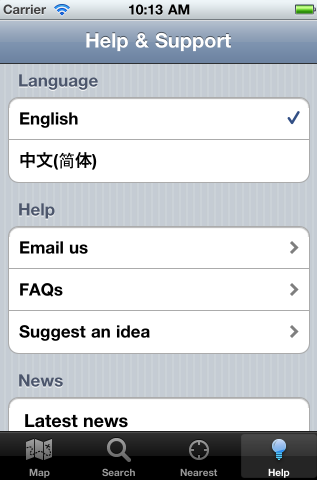
4. Instant language switch, and new help section
A brand new help section with links to our new support forum. And, by popular demand, you'll be able to instantly switch languages, without needing to quit the app.
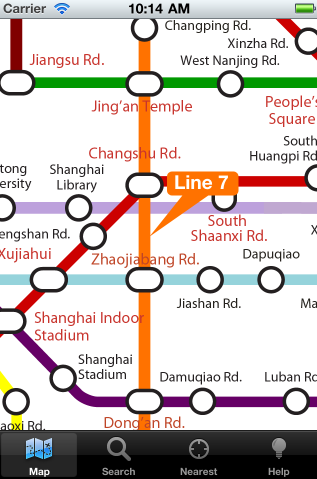
5. Line previews
Rather than have to scroll the map to find a legend, you can now press on any line to quickly see the name of the line.
The new versions will be available in the next few weeks. If you'd like to help test the new versions, please consider joining our beta-tester program.
I was recently interviewed by Allie Johnson of China Radio International. We talked about my motivations for creating the Explore Metro maps and my plans for the future! Listen to the audio here, or view the transcript below.
Allie: In every city Matt Mayer travels to, there’s one site he can’t miss.
Matt: I am a big fan of metros. Whenever I’m in town, I try to visit as many of the stations as I can.
Allie: When the Brit moved to Shanghai four years ago, that pastime got a little tricky.
Matt: I really wanted to use public transport to get around but when I searched online, I found that there wasn’t really any good information in English about the metro. I found some metro maps but often they would be like out of date or they wouldn’t include the correct station engine in English. So I thought, “I think I can do better than that myself.”
Allie: Mayer wanted to make the best metro map and trip planner in China. He went to great lengths to make it accurate: really great lengths.
Matt: A couple of years ago, I tried to visit every metro station in Shanghai in a single day. Starting at 6:00 in the morning, finishing late in the evening. It took me just over ten hours to visit every station. Althoufg that was before, some of the new lines have opened. I think if you try to do the same thing today, it would take even longer and it might not even be possible.
Allie: And so Explore Metro was born. It’s an online map of rapid transit systems in Shanghai, Beijing, Guangzhou, Hong Kong, Taipei, and Singapore. And there’s an iPhone app too. You can click on any station on the network, and drag to any other station to find best routes, trip times, and fares. You can also see first and last train times, Google maps of the area round the station, and links to info on nearby places.
All maps are bilingual and non-Chinese speakers can hear the station name in Mandarin.
Allie: Mayer says about 80% of users are Chinese.
Matt: And I do get quite a lot of feedback from Chinese people who are quite surprised that a foreigner actually took the time to make something like this.
Allie: In the past two years, the Shanghai metro has opened three new lines and expanded four. For Jonathan McDonald, this is where Explore Metro comes in handy.
Jonathan McDonald: I don’t know these new subway lines. I don’t know where they go. I don’t know how to connect with them. I don’t know what the fastest routes are. But this really shows me where to go.
Allie: Peggy Wong is living between Beijing and Shanghai. She just recently discovered the site.
Peggy: I think it’s very useful like it’s very user friendly. It’s great that they have such function because normally the map has a lot of stations and it’s a lot easier to pinpoint where the station I need to go.
Allie: But Wong and McDonald both say the maps have room to improve.
Peggy: I cannot zoom in or out so I can only see like a part of the metro map. So if I need to go from a very far end of one side of the city to go to the other side, I go back and forth, like side to side on the map.
Allie: McDonald says he doesn’t feel it accounts for the extra time needed to switch trains at busy interchange stations especially at rush hour.
Jonathan McDonald: I made a route between an interchange that is notoriously busy. And it didn’t give me a realistic journey time. You know, it said this will take you 13 minutes but speaking from personal experience, just that interchange could take you 10 minutes.
Allie: Matt Mayer says he welcomes anyone to write in with comments. And that almost every single added feature comes from user suggestion.
Matt: Although my Chinese is not too great, I do try to reply to everybody whether they’re writing to me in English or Chinese and I can email them back and let you know if it makes into a new version of the app.
Allie: Next stops are Explore Tokyo and Explore Seoul. He plans to keep the project Asia-focused because the rapid transit systems here are expanding so quickly. Currently, Mayer is travelling the world and working remotely. And wherever he can, ride in the rails. For CRI, I’m Allie Johnson.
The Shanghai Metro station which recently opened next to the new sports complex for the 2011 World Aquatics Championship has had a name change. It will now be called simply "Oriental Sports Center" (东方体育中心). Oriental Sports Center station is the terminus of Line 6, as well as serving Line 8.
It is quite unusual for Shanghai Metro stations to be renamed after opening. After several stations on Line 2 were renamed back in 2006, the Shanghai Metro announced it would avoid name changes in future due to passenger confusion and cost.
Pop quiz: which Shanghai Metro station was originally known as Xinlonghua (新龙华)?
The station on Shanghai Metro Line 1 and Line 10 called 陕西南路 in Chinese is one of the busiest stations on the network. But what's its English name? South Shanxi Road or South Shaanxi Road?
The confusion stems from a number of factors. There are two Chinese provinces with very similar names: 1. 陕西, pinyin Shǎnxī (third tone, first tone) 2. 山西, pinyin Shānxī (two first tones)
Because Chinese place names are often written without tone marks, in order to distinguish the two, the Romanization "Shaanxi" is often used for 陕西. This comes from an older romanization than Hanyu Pinyin, called Gwoyeu Romatzyh.
So, although 陕西南路 in Pinyin is Shǎnxī Nánlù, an acceptable English translation is South Shaanxi Road. This is the most commonly used form on official Shanghai Metro signage and maps, and therefore it's the version we adopt for Explore Shanghai.
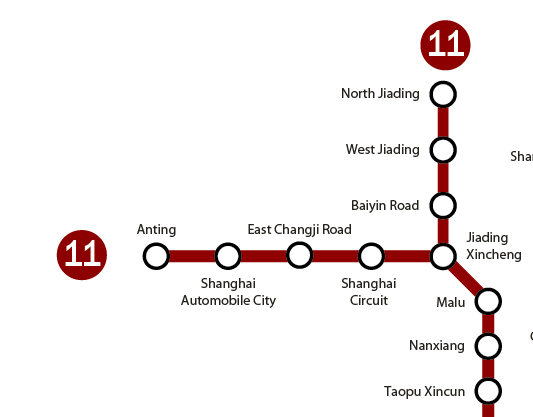
On April 26th, East Changji Road station (昌吉东路) opened on the Anting branch of Line 11 of the Shanghai Metro. While the rest of the line opened last year, East Changji Road, which is located between Shanghai Circuit, home of the Shanghai F1 race, and Shanghai Automobile City, wasn't ready to open with the rest of the line.
We're pleased to announce that ExploreMetro has a new support website, including a feedback forum for feature suggestions, a Knowledge Base with answers to common questions, and an easy way to contact us.
Despite the fact that ExploreMetro is developed, marketed and supported by one person in their spare time, I do love to hear what you have to say! Almost every feature we add to the app, or new city map we develop, is first suggested by one of our awesome users.
Shanghai Metro riders now have a new station to interchange at, with the opening of Jiyang Road, which provides a connection between Line 6 and Line 8.







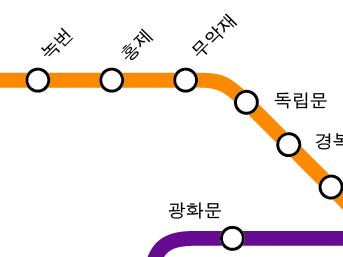 저희 회사는 곧 서울 지하철에서 사용될 앱을 출시할 예정입니다. 그래서 앱을 테스트할 사람이 필요합니다(그리고 한국어 번역도 확인해 줄 사람이 필요합니다). 저희 회사의 앱을 테스트하는데 참여하실 분은 아래 코멘트를 남겨주십시오.
 Shanghai Metro riders now have a new station to interchange at, with the